- Home
- Invoice Templates
- Contractor
Contractor and Construction Invoice Template
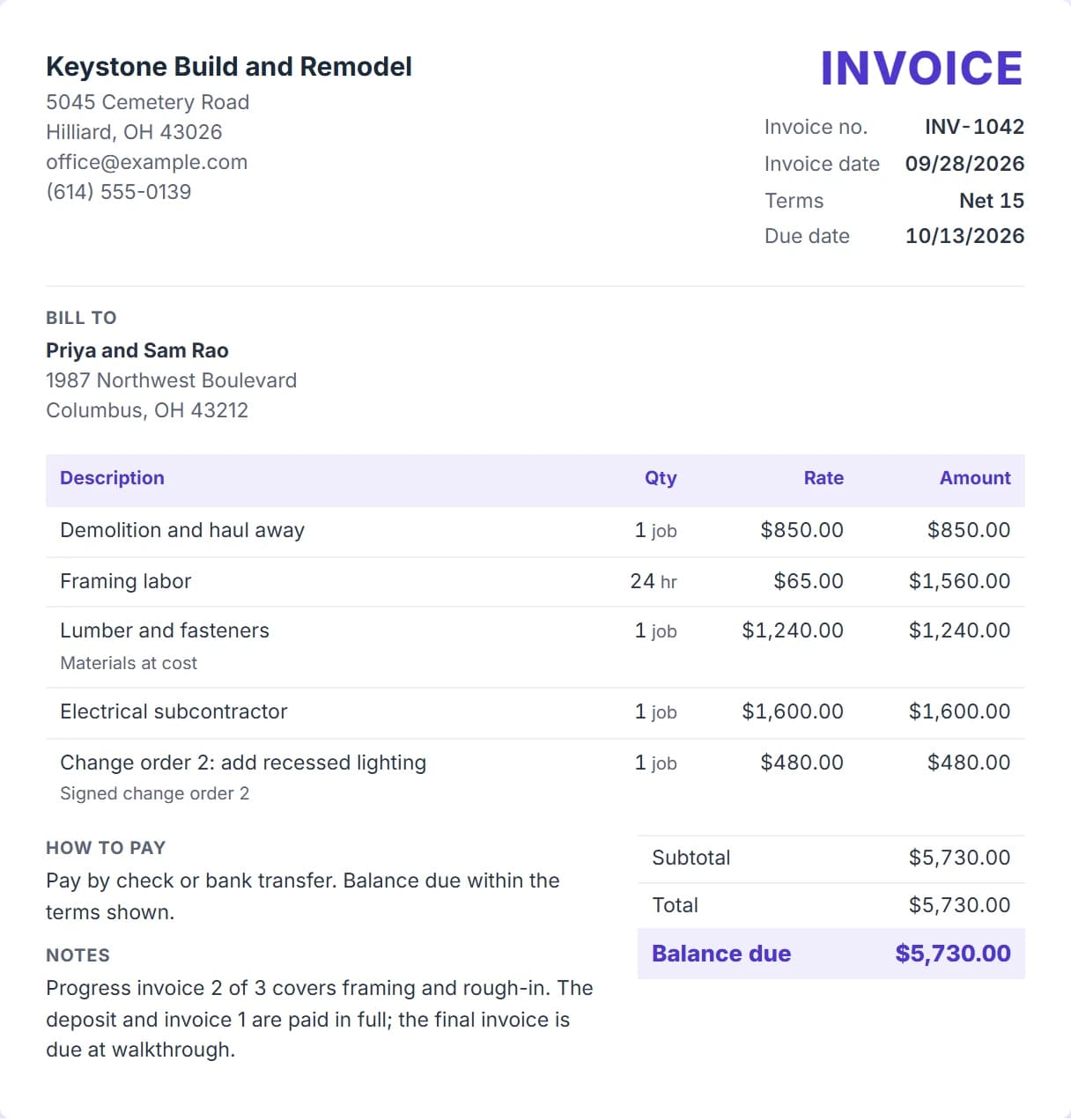
Building and remodeling jobs are paid in stages, so each contractor invoice has to show what this stage costs, what has been paid and what is still owed. This construction invoice template does that math for you.
Free, no signup. Reviewed by M. Humza.
Hilliard, OH 43026
office@example.com
(614) 555-0139
| Invoice no. | INV-1042 |
| Invoice date | 09/28/2026 |
| Terms | Net 15 |
| Due date | 10/13/2026 |
Columbus, OH 43212
| Description | Qty | Rate | Amount |
|---|---|---|---|
| Demolition and haul away | 1 job | $850.00 | $850.00 |
| Framing labor | 24 hr | $65.00 | $1,560.00 |
| Lumber and fastenersMaterials at cost | 1 job | $1,240.00 | $1,240.00 |
| Electrical subcontractor | 1 job | $1,600.00 | $1,600.00 |
| Change order 2: add recessed lightingSigned change order 2 | 1 job | $480.00 | $480.00 |
Pay by check or bank transfer. Balance due within the terms shown.
Progress invoice 2 of 3 covers framing and rough-in. The deposit and invoice 1 are paid in full; the final invoice is due at walkthrough.
| Subtotal | $5,730.00 |
| Total | $5,730.00 |
| Balance due | $5,730.00 |
Sample data. Names are invented and prices are placeholders to show the layout, not market rates.
Deposits, progress payments and the final bill
Contractors usually bill in stages: a deposit when the contract is signed, progress payments at milestones, and the balance at completion. Each invoice should show what has been paid so far and what is due now.
Some states limit deposits on home improvement jobs. California, for example, caps the down payment on a home improvement contract and, unless the contractor carries an approved bond, does not allow payments ahead of the work done or materials delivered. Check the rules in your state before asking.
Change orders belong on their own lines with a reference to the signed change order, so the invoice matches the paperwork if the total is ever questioned.
What ties an invoice to the contract
- Project name and job site address. So the invoice ties to one contract and one property.
- Contractor license number. Under your business name in states that license builders.
- Milestone or stage. For example rough-in complete, or invoice 2 of 3.
- Change orders. Each with its change order number.
- Deposit and payments received. Entered as payments, so the invoice ends with the balance due.
Preparing a progress invoice
- Reference the contract. Project name, job site and contract date in the notes.
- Say which stage this covers. "Progress invoice 2 of 3: framing and rough-in" tells the client where the job stands.
- Split labor, materials and subcontractors. Materials at cost or at your contract price, and each subcontractor's work on a line.
- Add each signed change order. One line per change order, numbered to match the signed paper.
- Subtract what has been paid. The deposit and earlier invoices go under Payments received, and the balance due follows.
- Attach what the contract asks for. A lien waiver, photos or an inspection sign-off, if required, before you send.
Contractor invoice example
Progress invoice 2 of 3 on a remodel, as the generator works it out.
| Line | Quantity and rate | Amount |
|---|---|---|
| Demolition and haul away | 1 job at $850.00 | $850.00 |
| Framing labor | 24 hr at $65.00 | $1,560.00 |
| Lumber and fastenersMaterials at cost | 1 job at $1,240.00 | $1,240.00 |
| Electrical subcontractor | 1 job at $1,600.00 | $1,600.00 |
| Change order 2: add recessed lightingSigned change order 2 | 1 job at $480.00 | $480.00 |
| Subtotal | $5,730.00 | |
| Total, net 15 | $5,730.00 | |
No tax appears because Ohio treats remodeling as a construction contract: the builder pays sales tax on lumber, fixtures and other materials at purchase and adds none to the customer's bill. States handle materials and labor differently, so check yours before you send.
Payment terms: Net 15
The sample gives the homeowners Net 15 on a progress bill. Many construction contracts set their own payment schedule for each milestone; when yours does, follow the contract and pick the matching terms.
Construction invoice for Word and Excel
The Word and Excel versions carry the demolition, framing, subcontractor and change order lines, so a progress bill is mostly a matter of changing amounts.
- Contractor invoice template for Word (.docx)
- Contractor invoice template for Excel, with formulas (.xlsx)
- Blank printable invoice form (PDF)
- Fillable invoice form (PDF)
Blank copy in Google DocsBlank copy in Google Sheets
From signed estimate to final receipt
Most jobs start from a signed estimate. The contractor estimate template uses the same lines plus a deposit and a signature block. When the final payment clears, a contractor receipt closes out the job.
Sources
- Ohio Administrative Code 5703-9-14, sales and use tax on construction contracts
- California Business and Professions Code section 7159.5