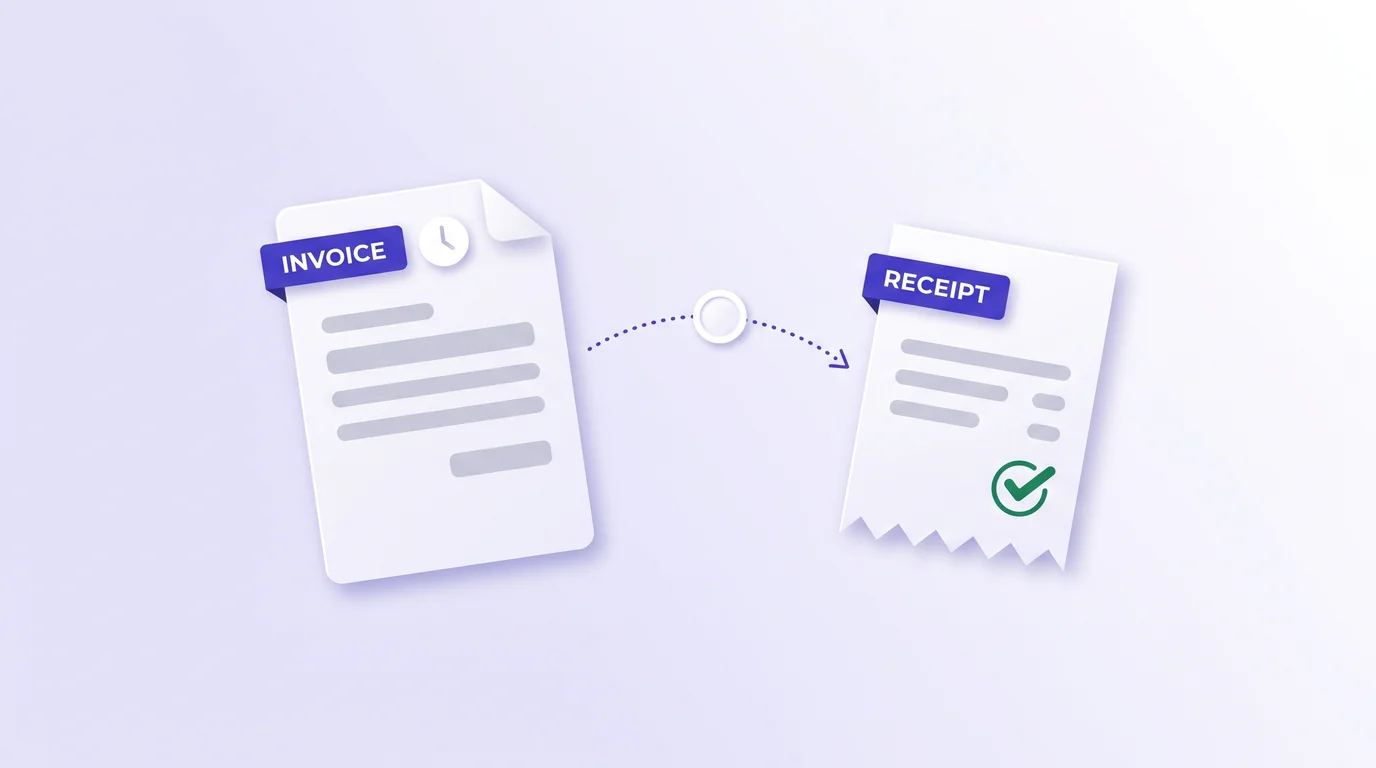
An invoice asks for money; a receipt says the money arrived. The seller sends the invoice first, when payment is still owed, and issues a receipt once the customer pays. Neither replaces the other: the invoice proves what was agreed, and the receipt proves the debt is settled.
The easiest way to see the difference is to follow one sale through every piece of paper it produces.
One order, four documents
Alder & Pine Woodworks, an invented two-person shop in Columbus, Ohio, builds four oak shelving units for a bookstore. The shop bills the job, takes a deposit by check the next day, and is paid the rest by card two weeks later. Here is every document, made in our generators:
| Date | Document | What happened | Amount | Still owed |
|---|---|---|---|---|
| Oct 1 | Invoice INV-2207 | Bills the job, Net 15 | $3,753.00 owed | $3,753.00 |
| Oct 2 | Receipt RCPT-0412 | Deposit by check, $1,500.00 | $1,500.00 received | $2,253.00 |
| Oct 2 | Updated invoice INV-2207 | Same invoice, now showing the deposit | $2,253.00 balance due | $2,253.00 |
| Oct 15 | Receipt RCPT-0419 | Final payment by card | $2,253.00 received | $0.00 |
Notice what changes and what does not. The invoice number stays the same from start to finish, because it identifies the debt. Each receipt gets its own number, because each one records a separate payment.
The updated invoice on October 2 is still an invoice. It shows the deposit and a lower balance, but it asks for money, so it is not a receipt.
The same sale, field by field
Put the opening invoice beside the final receipt and the fields line up almost exactly. What differs is the verb: one says “please pay”, the other says “paid”.
| Field | Invoice | Receipt |
|---|---|---|
| Title at the top | INVOICE | RECEIPT |
| Number | INV-2207 | RCPT-0419 (refers to INV-2207) |
| Date | October 1, 2026, the day it was sent | October 15, 2026, the day the money arrived |
| What it says | Please pay this amount | This amount was paid |
| Terms and due date | Net 15, due October 16, 2026 | None: nothing is due |
| Items, tax and total | Yes: $3,400.00 of shelving, $75.00 delivery, $278.00 sales tax | Often repeated, or a reference to the invoice |
| Amount | $3,753.00 due | $2,253.00 received |
| How it was paid | How to pay (instructions) | Credit or debit card, ending 4410 |
| Amount in words | Not usual | Two thousand two hundred fifty-three and 00/100 dollars |
| Who keeps it | Customer pays from it; seller tracks it as owed | Customer keeps it as proof; seller files a copy |
The written-out amount on the receipt is a habit carried over from paper receipt books and checks. It makes a handwritten figure harder to alter, and our receipt generator adds it automatically. How to write a receipt covers writing one by hand.
Can one document be both?
Yes, when the customer pays at the moment of sale. A shop till slip or a “sales receipt” lists the items, the tax and the payment together, because there was never a period when money was owed. Bookkeeping software often has a separate sales receipt for this case, for the same reason.
An invoice can also become proof of payment once it is marked paid in full, with the date and the payment method written on it. That works for a single payment. When a job is paid in stages, like the shelving above, separate receipts keep each payment’s date and amount clear.
What a document cannot do is serve as a receipt before the money has actually arrived. Hold the receipt until the check clears or the transfer lands, especially for a large first payment from a new customer.
Which one do the IRS and your employer want?
For your own books, keep both. IRS Publication 583 lists sales slips, paid bills, invoices, receipts, deposit slips and canceled checks as the supporting documents behind the entries on a tax return. An invoice shows what you sold or bought; a receipt or bank record shows it was paid.
Publication 463 makes the same point about expenses: a canceled check together with a bill from the payee ordinarily establishes the cost, but the check alone does not show a business purpose. In practice, an invoice plus proof of payment is the pair that holds up.
Employee reimbursements under an accountable plan work the same way. The IRS does not require documentary evidence for an expense under $75, other than lodging, so small items can be listed on an expense report. Anything at or over that amount needs the receipt.
Keep the records for as long as they could matter for a return: 3 years in most cases, longer in a few situations covered by the IRS record retention rules.
Invoice, bill or receipt: whose word is it?
“Bill” and “invoice” usually name the same document from opposite sides of the counter. The seller sends an invoice; the buyer receives a bill. A restaurant check is a bill in everyday speech, and the slip you get after paying it is the receipt.
A statement is different again: a summary of several invoices and payments on one account, often monthly. It is useful for chasing a balance, but each sale still needs its own invoice.
Mistakes that cause disputes
- A receipt with no link to the invoice. Put the invoice number on every receipt, so a partial payment is applied to the right job.
- Calling a deposit invoice a receipt. An invoice that requests a deposit is still a request. The receipt comes after the deposit is paid.
- Changing the invoice number after a payment. Reissue the same number with the payment shown, or the customer may think a second bill is due.
- No payment method on the receipt. “Check no. 1187” or “card ending 4410” lets either side trace the payment later.
Rent is one area where receipts carry legal weight: New York and Maryland, for example, require landlords to give receipts for some rent payments. The rent receipt template covers those rules.
Making each one
Bill the job with the free invoice generator: it sets the due date from the payment terms and shows any deposit already received. When money comes in, the receipt generator records the amount, method and remaining balance for partial payments. Both download as PDF with no sign-up.
Still unsure what belongs on the invoice itself? What is an invoice goes through each part on a worked example, and Net 30 and other payment terms explains the due dates.
Sources: IRS Publication 583, Starting a Business and Keeping Records; IRS Publication 463, chapter 5, Recordkeeping; IRS, How long should I keep records?; Ohio Revised Code 5739.01. Checked October 19, 2026.