An invoice is a document a seller sends a buyer to ask for payment for goods or services. It lists what was supplied, what each item costs, the total owed and when payment is due. To the seller it is an invoice; the buyer usually calls the same document a bill.
In brief: an invoice asks for money that is owed; a receipt confirms money was paid. A clear invoice names both parties, has a unique number and date, lists each line, adds tax, subtracts any deposit and states the terms. It is also a record the IRS expects a business to keep.
What is an invoice?
An invoice is a written request for payment. A business sends one after it delivers goods or finishes work, or at agreed stages of a longer job. It turns a sale into a record: who sold what to whom, on which date, for how much, and by when the money is due.
The same piece of paper has two names. The seller who issues it calls it a sales invoice and records it as money it is owed (accounts receivable). The buyer who receives it calls it a bill or purchase invoice and records it as money it owes (accounts payable).
What does an invoice look like? A worked example
Here is a real invoice made with our invoice generator. A print shop in Columbus, Ohio bills a cafe for printed tote bags and a screen setup, gives a repeat customer discount, charges delivery and subtracts a deposit already paid.
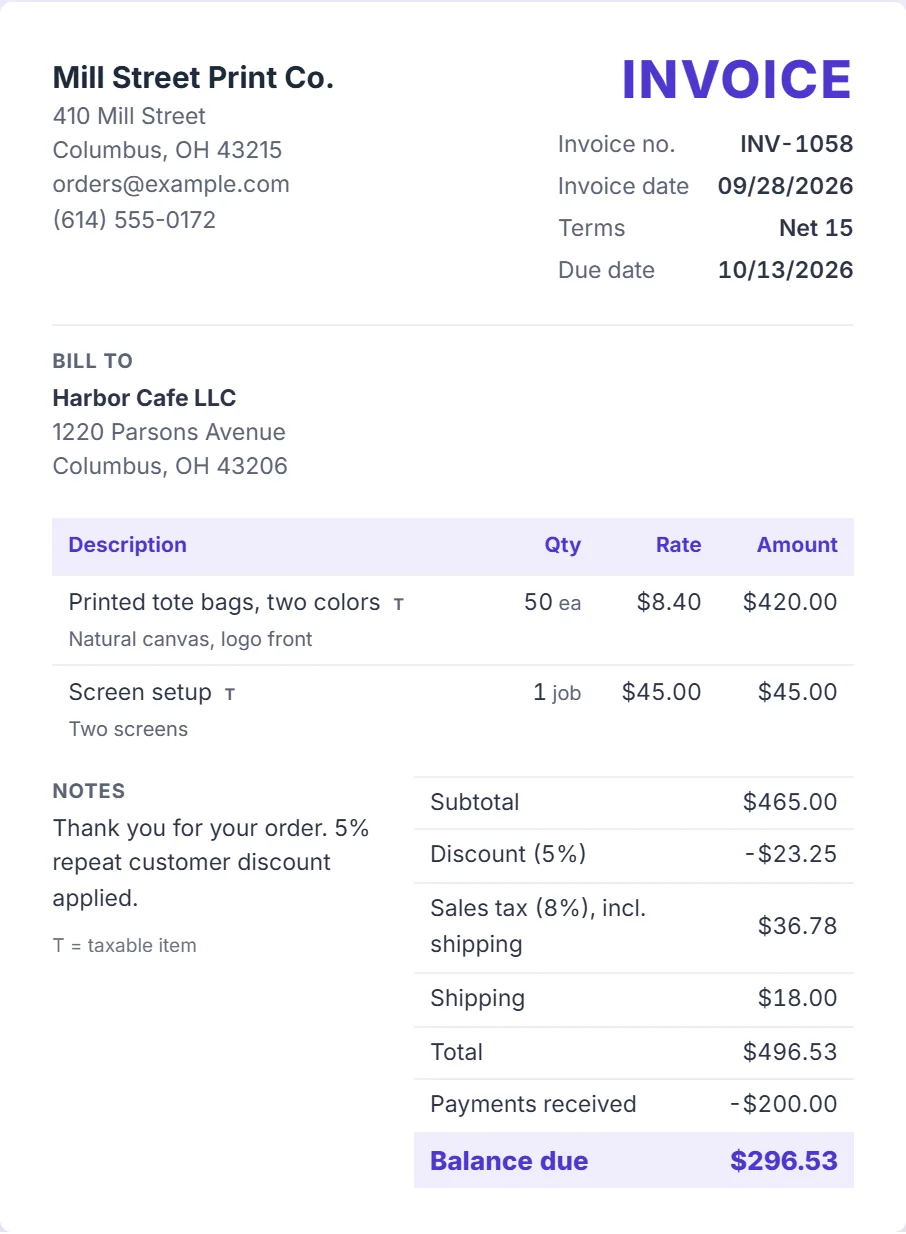
The table below takes the same invoice apart. Every amount is calculated by the generator, so the figures match the PDF to the cent.
| Part | On the sample invoice |
|---|---|
| 1 Seller | Mill Street Print Co. 410 Mill Street Columbus, OH 43215 orders@example.com (614) 555-0172 |
| 2 Bill to | Harbor Cafe LLC 1220 Parsons Avenue Columbus, OH 43206 |
| 3 Invoice number | INV-1058 |
| 4 Invoice date | 09/28/2026 |
| 5 Terms and due date | Net 15, due 10/13/2026 |
| 6 Line items | Printed tote bags, two colors: 50 ea at $8.40 = $420.00 Screen setup: 1 job at $45.00 = $45.00 |
| 7 Totals | Subtotal: $465.00 Discount (5%): -$23.25 Sales tax (8%), incl. shipping: $36.78 Shipping: $18.00 Total: $496.53 Payments received: -$200.00 Balance due: $296.53 |
| 8 Notes | Thank you for your order. 5% repeat customer discount applied. |
Read the totals from the top down. The discount comes off the subtotal first, sales tax is worked out on what is left, and delivery is added. The deposit is then subtracted, so the balance due is what the cafe still has to pay by the due date.
Delivery is taxed here because Ohio counts delivery charges as part of the taxable price of goods (Ohio Revised Code 5739.01). Other states treat delivery differently, so check your own state’s rule before you copy the tax line.
What should an invoice include?
The IRS does not set an invoice layout. It asks that a business keep records that clearly show its income and expenses (IRS: what kind of records should I keep). In practice, clients pay faster when an invoice answers their questions before they ask. These are the parts most invoices carry:
- Your business details: name, address, email or phone, and a license number if your trade needs one on paperwork.
- The client: the person or company paying, with a contact or accounts payable line for a business client.
- Invoice number and date: a unique number that never repeats, so both sides can refer to this invoice alone.
- Payment terms and due date: such as due on receipt or Net 15, which means payment is due 15 days after the invoice date.
- Line items: each product or service with its quantity, unit, price and line amount.
- Totals: subtotal, any discount, sales tax, shipping, payments already received and the balance due.
- How to pay: who to make a check payable to, bank transfer details or a payment link.
Add a purchase order number when a business client gave you one. Some accounts payable teams will not pay an invoice that does not quote it. To put all of this together for the first time, follow how to write an invoice step by step.
Why invoices matter
Getting paid. An invoice sets the amount and the due date in writing. When a payment is late, it is the document you point to, and the invoice number lets the client’s bookkeeper find it in seconds.
Your tax records. The IRS lists invoices among the supporting documents that show the amount and source of a business’s gross receipts. It says to keep such documents in order and in a safe place, because they back up the entries in your books and on your return.
How long to keep them depends on the return they support. The general IRS period is 3 years after you file, and 6 years if you left a large share of your income off the return (IRS: how long should I keep records).
Types of invoices
Most small businesses only ever send a standard invoice, but a few other kinds come up as jobs get bigger or clients get more formal:
| Type | When it is used |
|---|---|
| Standard invoice | Bills for goods or work already delivered. The everyday kind. |
| Proforma invoice | A preview of a future invoice, sent before delivery so the buyer can approve or arrange payment. It does not request payment for completed work. |
| Progress (interim) invoice | Bills part of a long job at agreed stages, such as a percentage of a construction contract. |
| Final invoice | Closes a job billed in stages, showing what was billed before and the remaining balance. |
| Recurring invoice | Bills the same amount on a schedule, such as a monthly retainer or service plan. |
| Credit memo | Reduces what a client owes on an earlier invoice, for a return, an error or a price adjustment. |
| Commercial invoice | Travels with goods shipped abroad and gives customs the value and description of the shipment. |
Invoice vs bill, receipt, estimate and purchase order
These documents are easy to mix up because they often carry the same line items. The difference is who sends each one and when in the sale it is sent. For one order followed through its invoice and receipts, see invoice vs receipt.
| Document | Sent by | When | What it does |
|---|---|---|---|
| Estimate or quote | Seller | Before the work | Proposes a price for the client to accept |
| Purchase order | Buyer | Before delivery | Places an order and approves the spend |
| Invoice | Seller | After delivery or at agreed stages | Asks for payment |
| Bill | Same document as the invoice | When the buyer receives it | The buyer’s name for an invoice it must pay |
| Receipt | Seller | After payment | Confirms the money was received |
Each one has its own free generator: the estimate generator before the job, the invoice generator to bill it, and the receipt generator once the client has paid.
Does an invoice mean I owe money?
Only if you or your business actually ordered the goods or services. An invoice is a request, not proof of a debt. If an invoice arrives for something nobody ordered, check it against your own orders, quotes or purchase orders before anyone pays.
The Federal Trade Commission warns that scammers send phony invoices for things like office or cleaning supplies and domain name registrations, hoping whoever pays the bills assumes they are real (FTC: scams and your small business). Report one at ReportFraud.ftc.gov.
Invoice templates by trade
What goes on the line items changes from trade to trade: hours and parts for a plumber, sessions and usage rights for a photographer. Each of these opens a sample invoice for that trade, with free Word, Excel and PDF templates:
- Plumbing invoice template
- HVAC invoice template
- Electrician invoice template
- Contractor invoice template
- Handyman invoice template
- Cleaning invoice template
- Landscaping invoice template
- Auto repair invoice template
- Consulting invoice template
- Freelance invoice template
- Photography invoice template
Prefer a blank file? The invoice templates hub has Word, Excel with formulas, Google Docs and fillable PDF versions.