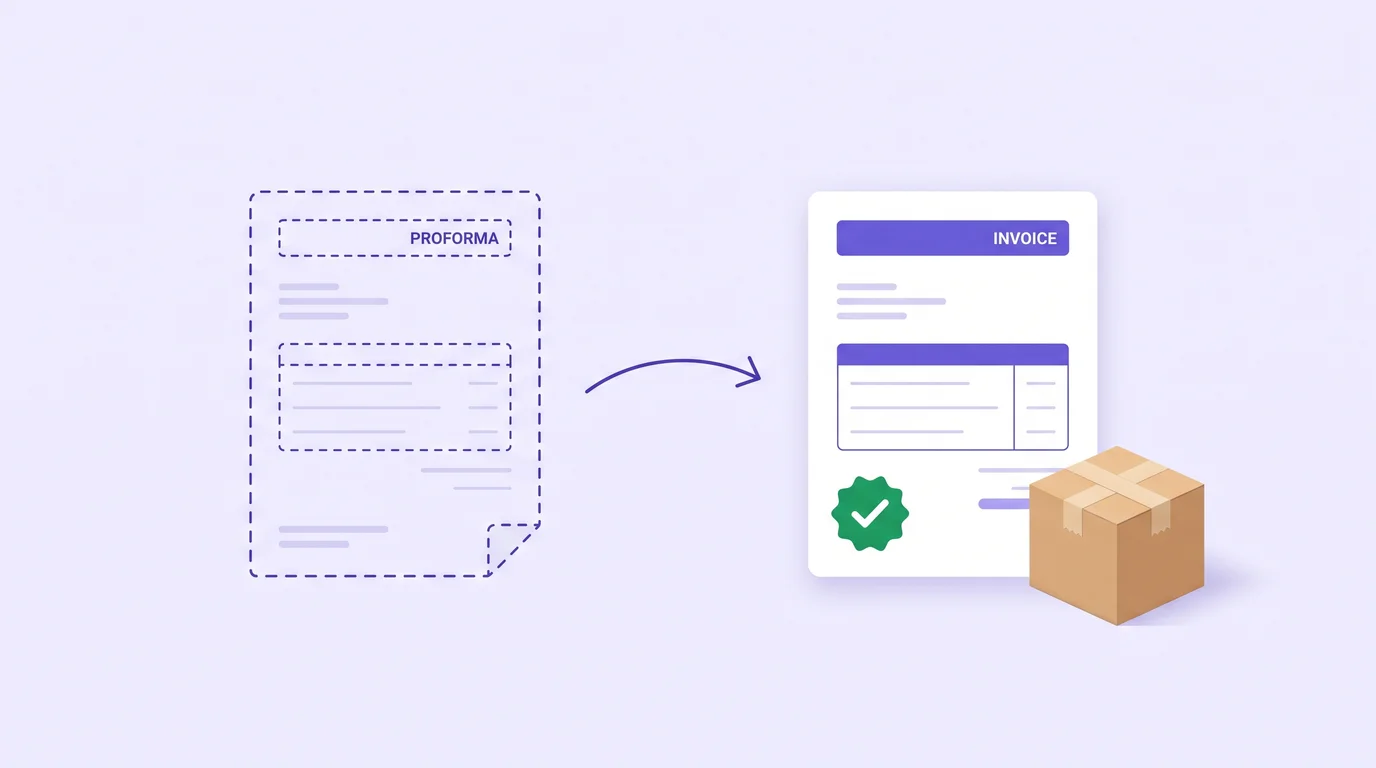
Before a buyer pays for goods that have not shipped yet, they often ask for a proforma invoice: a priced preview of the invoice they will receive, sent so they can approve the spend, arrange payment or prepare an import.
It looks like an invoice and lists the same lines, but it is a commitment to terms, not a bill for a finished sale.
The name is Latin, “as a matter of form”. The International Trade Administration describes it as a quote in an invoice format (trade.gov).
Quote, proforma invoice or invoice?
The three documents can carry identical line items. What differs is when they are sent and what they ask the buyer to do:
| Quote or estimate | Proforma invoice | Invoice | |
|---|---|---|---|
| Sent | While the buyer is deciding | After the buyer says yes, before delivery | When the goods ship or the work is done |
| Asks for | A decision | Approval, an advance payment or paperwork the buyer needs | Payment of the amount due |
| Can change? | Freely, until accepted | Only with the buyer’s agreement | Only by a corrected invoice or credit |
| In your books | Not recorded | Not recorded as a sale | Recorded as a sale and a receivable |
| Numbering | Its own series | Its own series, such as PF-0114 | Your invoice sequence |
A proforma sits closer to the invoice than a quote does: the buyer has agreed, and the seller is now promising to ship on those terms. If you still need to price the job, start with an estimate instead.
One order, start to finish
A Columbus pottery studio takes its first wholesale order from a gift shop in Cincinnati. The shop has no credit history with the studio, so the studio asks for half the money before production starts and sends a proforma invoice to request it. Three weeks later the order ships and the final invoice follows:
| Line | Proforma invoice | Final invoice |
|---|---|---|
| Document | Proforma invoice PF-0114 | Invoice INV-1187 |
| Date | September 14, 2026 | October 5, 2026 |
| Stoneware mug, speckled glaze | 120 at $14.00 $1,680.00 | 120 at $14.00 $1,680.00 |
| Serving bowl, 10 inch | 40 at $32.00 $1,280.00 | 38 at $32.00 $1,216.00 |
| Bud vase, set of three | 24 at $26.00 $624.00 | 24 at $26.00 $624.00 |
| Freight | $95.00 (estimate) | $88.40 (actual) |
| Sales tax | None, resale certificate on file | None, resale certificate on file |
| Total | $3,679.00 | $3,608.40 |
| Paid before shipping | - | -$1,839.50 (50% deposit) |
| Amount due | $1,839.50 deposit to start production | $1,768.90, Net 15 |
Two things changed between the documents, as they often do. Two serving bowls failed inspection, so the final invoice bills 38 instead of 40, and the freight came in under the estimate. The deposit paid against the proforma is credited on the final invoice, which asks only for the balance.
In the studio’s books the deposit is a customer deposit, money held for an order not yet delivered. The sale is recorded with the final invoice, because revenue is recognized when the goods change hands (PwC on ASC 606).
Neither document charges sales tax because the shop is buying the pottery to resell it and gave the studio a resale exemption certificate (Ohio Revised Code 5739.03). On a taxable order, show the estimated tax on the proforma so the buyer budgets for it, and charge it on the final invoice.
When a proforma invoice is the right document
- The buyer needs approval first. A purchasing department or a grant budget may need a priced document before anyone can sign a purchase order.
- You want payment before you make or ship. Custom work, large first orders and new customers are typical. The proforma states the advance and the terms in writing.
- The goods are crossing a border. Foreign buyers may need one to apply for an import license, book a pre-shipment inspection, open a letter of credit or move money out of their country (trade.gov).
- Customs is waiting for paperwork. When an importer into the United States does not yet have the seller’s commercial invoice, Customs accepts a pro forma invoice in a set form, and the importer must file the real invoice once it arrives (19 CFR 141.85).
Proforma invoice vs commercial invoice
For exports, the proforma has a partner document: the commercial invoice. The proforma comes first, so the buyer can arrange an import license or a letter of credit. The commercial invoice travels with the shipment, is required for clearance, and customs in the buyer’s country uses it to assess duties and taxes (trade.gov).
The commercial invoice usually repeats what the proforma said and adds the Harmonized System (HS) code for each product, a universal description of goods for duty purposes. Keep the two consistent: the buyer arranged their import paperwork from the proforma, so change nothing without their consent.
For a routine domestic sale to a customer who pays on terms, skip the proforma altogether. Send the invoice when you deliver, as described in our guide to what an invoice is.
What to put on it
The International Trade Administration lists what an export proforma should carry. Domestic proformas need most of it too:
- Your name and address, and the buyer’s.
- The buyer’s reference, such as their purchase order number.
- The items, with unit prices and line totals.
- Weights and dimensions, for anything that ships.
- Discounts, if any.
- Terms of sale, with the Incoterm and delivery point for exports.
- Payment terms, including any advance.
- The estimated ship date and the date the prices are valid until.
Title it “Proforma invoice” so nobody pays it twice or books it as a sale, and number it in its own series. When the order ships, issue a normal invoice with a new number from your invoice sequence.
The invoice generator opens with the title set to Proforma invoice. Switch the title back to Invoice for the final bill, and record the advance under Payments received so the balance comes out right. When the buyer pays, a receipt confirms it.