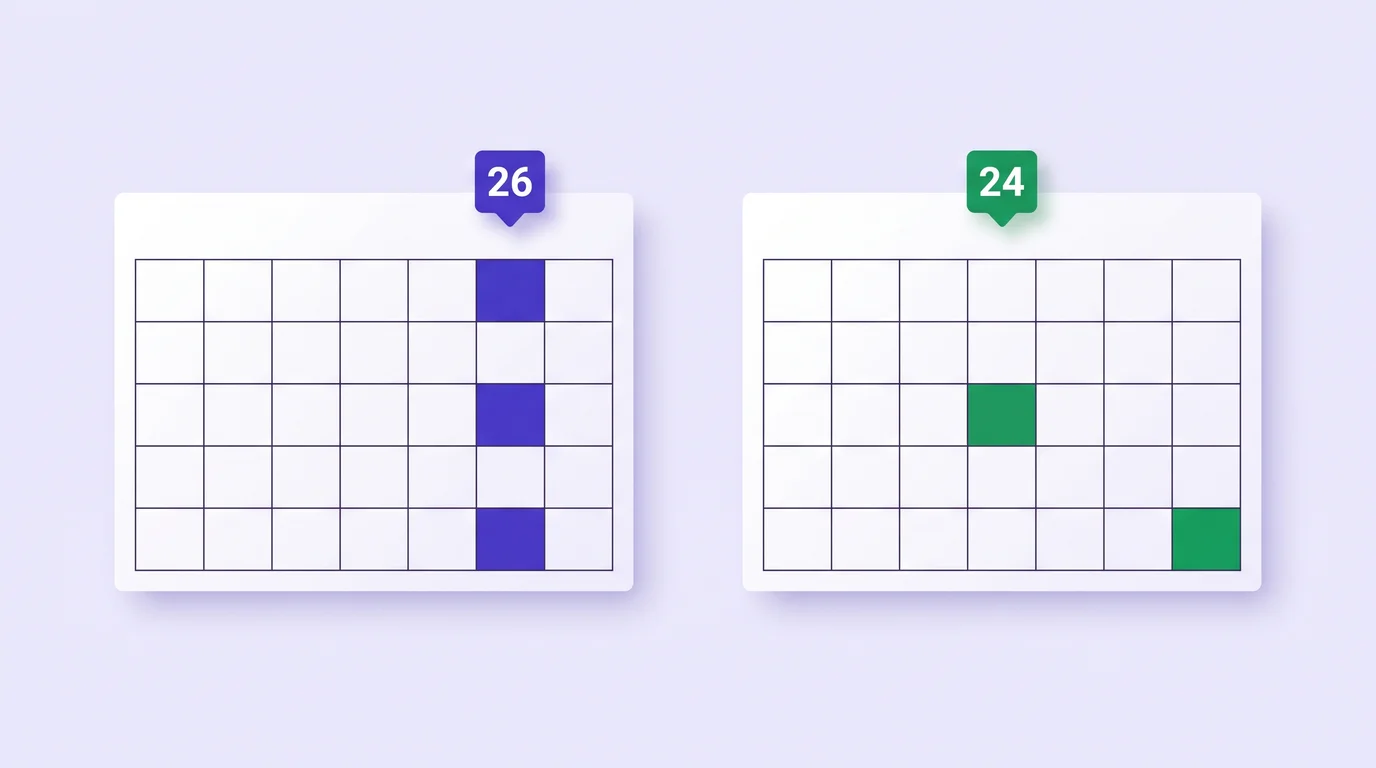
Biweekly pay comes every other week on the same weekday, 26 times a year. Semimonthly pay comes on two fixed dates each month, such as the 15th and month end, 24 times a year.
Over a year the pay adds up to the same salary; what changes is the size of each check, its timing and, for hourly staff, the hours it covers.
One salary, paid both ways
We ran a $62,400 salary for a single filer in Howard County, Maryland, through our pay stub generator on both schedules. Biweekly splits the salary into 26 checks of $2,400. Semimonthly splits it into 24 checks of $2,600.
| Line | Biweekly | Semimonthly |
|---|---|---|
| Gross pay per check | $2,400.00 | $2,600.00 |
| Federal income tax | $204.15 | $221.17 |
| Social Security | $148.80 | $161.20 |
| Medicare | $34.80 | $37.70 |
| Maryland and Howard County tax | $170.62 | $184.84 |
| Net pay per check | $1,841.63 | $1,995.09 |
| Net pay for the year | $47,882.38 26 checks | $47,882.16 24 checks |
Each semimonthly check is bigger, and every tax on it is bigger too, because withholding is figured per pay period. But multiply out the year and net pay comes within a few cents of matching: 26 smaller checks and 24 larger ones leave the employee with practically the same take-home pay.
Both FICA taxes, Social Security and Medicare, are flat rates, so they scale exactly with gross pay. Federal and state income tax use per-period tables from IRS Publication 15-T and the state, which annualize the check and are built so either schedule withholds about the same over a year.
Why hourly checks swing on a semimonthly schedule
A biweekly period always contains ten weekdays. A semimonthly period runs from the 1st to the 15th or the 16th to the end of the month, and the number of weekdays in it shifts with the calendar.
Someone hourly working a steady 40 hours a week gets 80 hours on every biweekly check, but anywhere from 80 to 96 on a semimonthly one.
For someone earning $20 an hour, that is $1,600 every biweekly payday against $1,600 to $1,920 on a semimonthly payday. Nothing is lost over the year; the money just arrives unevenly. Salaried pay does not swing, because the salary is split into equal parts whatever the calendar holds.
Overtime when the pay period is not a workweek
Federal overtime is counted one workweek at a time. Hours cannot be averaged across two weeks, whether the employee is paid weekly, biweekly or monthly (29 CFR 778.104). A biweekly period holds exactly two workweeks, so the overtime lines up with the check.
A semimonthly period usually cuts a workweek in half.
The rule for timing is that overtime is paid on the regular payday for the period in which the workweek ends; when it cannot be worked out in time, it may be paid on the next payday, no later (29 CFR 778.106). That extra bookkeeping is the main reason hourly payrolls tend to run biweekly.
The two extra biweekly checks
Twenty-six checks spread over twelve months means two months get three paydays instead of two. On a Friday schedule in 2026, those months are January and July if the first payday was January 2, or May and October if it was January 9. The pay periods guide has the full calendar.
People on biweekly pay often budget as if every month had two checks and treat the third as a bonus month for savings or debt. Semimonthly pay matches monthly bills more neatly: rent and a car payment come once a month, and the two checks come at the same points in every month.
Which schedule should a small business choose?
- Mostly hourly staff: biweekly keeps every check to two whole workweeks, so hours and overtime are simpler to total.
- Mostly salaried staff: semimonthly gives equal checks on predictable dates and lines up with monthly accounting.
- Payroll cost: semimonthly means 24 payroll runs a year instead of 26, which matters if your payroll service charges per run.
- State law: most states set a minimum pay frequency, and some limit which schedules fit which employees. Florida and Alabama set none. Check the Department of Labor’s state payday table first.
Setting up payroll for the first time? How to do payroll for a small business walks through the whole cycle, from the EIN to the year-end forms.
Whichever you pick, the pay stub has to state the period it covers and the frequency, because the withholding tables depend on it. Our pay stub generator handles weekly, biweekly, semimonthly and monthly pay and carries the year-to-date totals across each pay date.
Switching from one schedule to the other
Changing schedules is mostly arithmetic, but the changeover needs care. Every day worked must fall in exactly one pay period, so the last period on the old schedule and the first on the new one have to meet with no gap and no overlap. That usually means one short transition check.
Salaried employees see the per-check gross change, from a 26th of the salary to a 24th or the other way. Per-check deductions such as health premiums may need resetting so the yearly total stays right. Year-to-date figures simply carry on, because they count dollars, not checks.
Give staff the new paydays in writing before the first changed check, and confirm the new schedule still meets your state’s minimum frequency in the Department of Labor payday table.
Biweekly, semimonthly or bimonthly?
Bimonthly is the confusing one. Dictionaries give it two meanings, every two months and twice a month (Merriam-Webster). The IRS withholding tables say semimonthly for twice a month, so that is the safest word to put in an offer letter or a handbook.