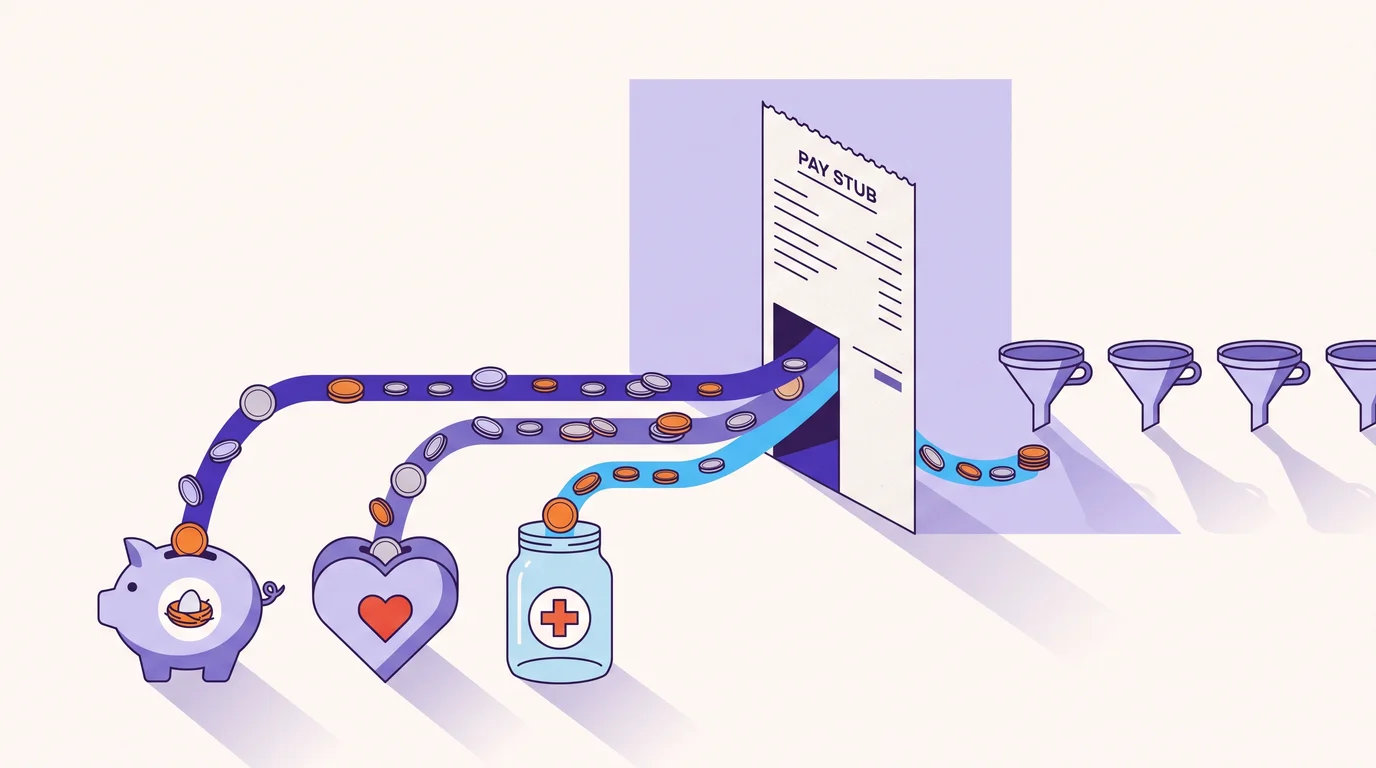
A pre-tax deduction is money taken out of your gross pay before one or more taxes are worked out. That tax is then figured on a smaller number. A 401(k) deferral, a health insurance premium and an HSA contribution are the common ones.
What catches people out is that “pre-tax” does not mean the same thing for every deduction. Some lower only income tax. Others lower Social Security and Medicare as well. The type decides how much a deduction actually trims your take-home pay.
Which taxes each pre-tax deduction lowers
The federal rules sit in IRS Publication 15-B for benefits and Publication 15 for retirement deferrals. Limits shown are for 2026.
| Deduction | Lowers federal income tax | Lowers Social Security and Medicare | 2026 limit |
|---|---|---|---|
| Traditional 401(k), 403(b) or 457(b) | Yes | No | $24,500, plus $8,000 catch-up at 50 or older (more at 60 to 63) |
| Medical, dental and vision premiums through a cafeteria plan | Yes | Yes | The plan’s premium |
| HSA contributions through a cafeteria plan | Yes | Yes | $4,400 self-only, $8,750 family |
| Health FSA | Yes | Yes | $3,400 |
| Dependent care FSA | Yes | Yes | $7,500 a household |
| Transit pass and commuter parking | Yes | Yes | $340 a month for each |
The middle column is the one to remember. Retirement deferrals still count as Social Security and Medicare wages. Cafeteria plan benefits, named after Section 125 of the tax code, come out ahead of all three federal taxes. Group-term life insurance has its own rule, covered in our guide to GTL on a pay stub.
The same paycheck four ways
To see the difference in dollars, we ran one employee through our pay stub generator four times: a single filer in Savannah, Georgia, paid $2,600 every two weeks. First with no deductions, then with a 6% 401(k), then with a $180 health premium, then with both.
| Line | No deductions | 6% 401(k) | $180 health premium | Both |
|---|---|---|---|---|
| Gross pay | $2,600.00 | $2,600.00 | $2,600.00 | $2,600.00 |
| Pre-tax deductions | $0.00 | $156.00 | $180.00 | $336.00 |
| Federal income tax | $232.38 | $209.43 | $206.55 | $187.83 |
| Social Security | $161.20 | $161.20 | $150.04 | $150.04 |
| Medicare | $37.70 | $37.70 | $35.09 | $35.09 |
| Georgia income tax | $100.95 | $93.17 | $91.97 | $84.19 |
| Net pay | $2,067.77 | $1,942.50 | $1,936.35 | $1,806.85 |
| Take-home pay given up | $0.00 | $125.27 | $131.42 | $260.92 |
The 401(k) line is 6% of gross, $156.00. The health premium runs through a Section 125 cafeteria plan.
Read across the Social Security and Medicare rows. They do not move when the 401(k) is added, but they drop when the health premium comes out. Federal and Georgia income tax fall in both cases, because both deductions shrink the wages those taxes are figured on.
The bottom row is the point. In every column, take-home pay falls by less than the amount deducted. The gap is tax the paycheck no longer has to withhold.
What $100 of deduction really costs you
Divide the take-home pay given up by the amount deducted and you get the real price of each dollar you set aside. On this paycheck:
An after-tax deduction costs exactly what it says. A 401(k) dollar costs about 80 cents here, and a cafeteria plan dollar about 73 cents, because it also escapes Social Security and Medicare. Someone in a higher tax bracket, or a state with a higher income tax, saves more per dollar.
A 401(k) is not tax free, though. The tax is deferred: withdrawals in retirement are taxed as income. Health and FSA money spent on qualifying expenses is never taxed at all.
State income tax does not always follow
Most states start from federal taxable wages, so a pre-tax deduction usually lowers state income tax too, as it did for Georgia above. A few states draw the line differently:
- Pennsylvania taxes employee contributions to 401(k) and similar deferred compensation plans, so they come off federal wages but not Pennsylvania wages (Pennsylvania Department of Revenue). Cafeteria plan health premiums are excluded there as they are federally.
- California does not follow the federal HSA rules. HSA contributions are taxable for California income tax, even when they come out of pay before federal tax (California Franchise Tax Board, Schedule CA instructions).
This is why box 16 on a W-2, state wages, can be higher than box 1.
Pre-tax vs after-tax deductions
After-tax deductions come out of pay once every tax has been worked out, so they lower take-home pay dollar for dollar. Common ones are below; post-tax deductions covers each with its stub labels and a Roth vs traditional comparison.
- Roth 401(k) contributions, which are taxed now so that qualified withdrawals later are not.
- Union dues and charitable gifts made through payroll.
- Wage garnishments and child support orders.
- Supplemental life or disability insurance that you choose to pay for after tax.
A good stub separates the two groups, so you can see which lines reduced your taxes. If yours lumps everything under one “Deductions” heading, the guide to what a pay stub shows explains what to ask your employer for.
How pre-tax deductions show up on your W-2
Each pre-tax deduction leaves a trace on the W-2, which is how you can check the treatment at year end:
- Box 1 (federal wages) is gross pay minus every deduction in the table above. That is why it is often lower than your last stub’s year-to-date gross.
- Boxes 3 and 5 (Social Security and Medicare wages) drop for cafeteria plan benefits but not for 401(k) deferrals. They are often higher than box 1.
- Box 12 lists the amounts by code. D is 401(k) deferrals, W is HSA contributions through the employer, and DD is the cost of health coverage, shown for information only.
- Box 10 shows dependent care benefits.
The full list of codes is in our W-2 box 12 guide, and the effect on federal withholding is in FIT on a pay stub.