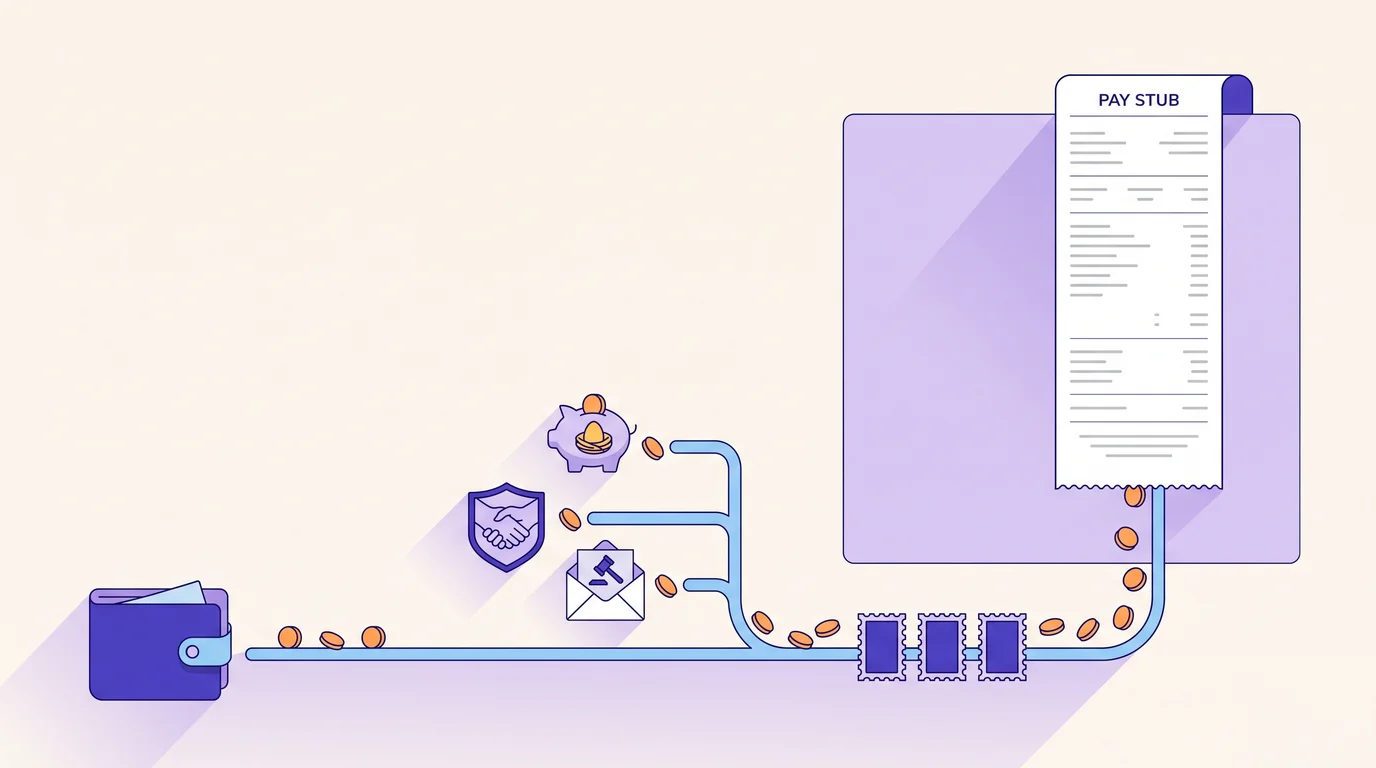
Below the taxes on a pay stub there is often a second list: Roth 401(k), union dues, a court order. These are post-tax deductions. Payroll subtracts them only once income tax, Social Security and Medicare are settled, so they shrink your take-home pay but leave your taxes exactly where they were.
Some you chose, such as a Roth contribution. Others you did not, such as a garnishment. Either way, each one costs you its full face value, dollar for dollar.
Post-tax deduction examples
These are the after-tax deductions that show up most often, with the labels payroll systems tend to print beside them. All are voluntary unless marked:
| Deduction | Why it comes out after tax | Labels you may see |
|---|---|---|
| Roth 401(k), 403(b) or 457(b) | You pay the income tax up front; qualified withdrawals come out free of it | ROTH, R401K, 401K-R |
| Disability insurance you pay for | Paying with taxed money keeps the benefits tax free | STD, LTD, DIS |
| Supplemental or voluntary life insurance | Extra cover beyond what the employer provides | SUPP LIFE, VOL LIFE |
| Union dues (may be set by a union agreement) | Not an excluded benefit | UNION, DUES |
| Charitable gifts through payroll | Not an excluded benefit | CHARITY, UWAY |
| Child support or alimony order (required) | Set by a court or agency on pay after taxes | CSUP, CS, GARN |
| Creditor, student loan or tax levy (required) | A legal order to withhold | GARN, LEVY, AWG |
| Repaying a payroll advance or loan (agreed) | Paying back money already received | ADV, LOAN |
What these share is that none of them is a tax-favored benefit. The deductions that do lower tax, such as cafeteria plan health premiums and traditional 401(k) deferrals, are covered in pre-tax deductions.
Roth or traditional: the same $150, two ways
The clearest way to see the difference is to send the same money to retirement both ways. Our pay stub generator worked out three versions of one Tulsa, Oklahoma paycheck: a single filer earning $2,400 every two weeks, saving nothing, then $150 traditional, then $150 Roth.
| Line | Nothing saved | $150 traditional 401(k) | $150 Roth 401(k) |
|---|---|---|---|
| Gross pay | $2,400.00 | $2,400.00 | $2,400.00 |
| Pre-tax deductions | $0.00 | $150.00 | $0.00 |
| Federal income tax | $204.15 | $186.15 | $204.15 |
| Social Security | $148.80 | $148.80 | $148.80 |
| Medicare | $34.80 | $34.80 | $34.80 |
| Oklahoma income tax | $87.02 | $80.27 | $87.02 |
| Post-tax deductions | $0.00 | $0.00 | $150.00 |
| Net pay | $1,925.23 | $1,799.98 | $1,775.23 |
| Take-home pay given up | $0.00 | $125.25 | $150.00 |
The traditional column withholds less federal income tax and Oklahoma income tax, because the $150 comes out first and those taxes are figured on $2,250. Social Security and Medicare, the two halves of FICA, do not change in either column. The Roth column is identical to the no-savings column until the very last line.
So the Roth contribution costs the full $150 of take-home pay, while the traditional one costs less, because part of it is tax not withheld today. That gap is the tax a Roth saver pays up front in exchange for tax-free qualified withdrawals in retirement.
Both kinds share one annual limit: $24,500 in 2026, plus a $8,000 catch-up from age 50, or $11,250 for most plans at ages 60 to 63. From 2026, anyone whose wages from that employer topped $150,000 the year before must make catch-up contributions as Roth (IRS).
Reading post-tax deductions on a pay stub
Here is the same Tulsa paycheck with three post-tax deductions at once: the $150 Roth contribution, $32 in union dues and a $250 child support order.
| Line | Common stub codes | This period |
|---|---|---|
| Gross pay | $2,400.00 | |
| Taxes withheld | ||
| Federal income tax | FIT, FED | $204.15 |
| Social Security | OASDI, SS | $148.80 |
| Medicare | MED, HI | $34.80 |
| Oklahoma income tax | OK SIT | $87.02 |
| Disposable earnings (gross less taxes) | $1,925.23 | |
| Post-tax deductions | ||
| Roth 401(k) | ROTH, R401K | $150.00 |
| Union dues | UNION, DUES | $32.00 |
| Child support order | CSUP, GARN, CS | $250.00 |
| Net pay | $1,493.23 | |
Federal law caps a child support order at 50% of disposable earnings, $962.62 on this check, when the worker supports another spouse or child, and 60%, $1,155.14, when they do not. The $250 order is well inside both.
The taxes are the same as on a paycheck with no deductions at all. Nothing in the second block reached back up to change them. If a stub you are checking shows income tax falling when a Roth or garnishment line appears, ask payroll how that deduction is set up.
The line in italics, disposable earnings, is not printed on most stubs. It matters because federal garnishment limits are measured against it, as the next sections show.
The order payroll works in
Payroll always follows the same sequence: gross pay, then pre-tax deductions, then taxes on what is left, then post-tax deductions, then net pay. This check has no pre-tax deductions, so it runs straight from taxes to the three after-tax lines.
The order explains why post-tax deductions never move your taxes: by the time they come out, the tax has already been calculated.
It also explains the W-2. Box 1 wages include Roth contributions, while code AA in box 12 reports Roth 401(k) money, BB Roth 403(b) and EE governmental Roth 457(b). The W-2 box 12 codes list has the rest.
Add post-tax deductions to a pay stub
Garnishments: the post-tax deductions you do not choose
A garnishment is a legal order telling an employer to send part of your pay to someone else. Federal law limits how much, measured against disposable earnings: pay left after legally required deductions such as taxes. Voluntary deductions like union dues and insurance usually are not subtracted first (Department of Labor Fact Sheet 30).
- Ordinary debts. The lesser of 25% of disposable earnings, or the amount above 30 times the federal minimum wage of $7.25. That floor is $217.50 a week, or $435.00 for a biweekly check, which cannot be touched.
- Child support and alimony. Up to 50% of disposable earnings if the worker supports another spouse or child, 60% if not, plus 5% more when payments are over 12 weeks behind.
Federal tax levies, bankruptcy orders and some state laws follow their own rules, and a state can protect more of your pay than the federal floor does. The order itself states the amount; payroll follows it.
Can you stop a post-tax deduction?
A voluntary one, usually yes. Roth contributions can be changed or stopped through your retirement plan, often from the next payroll. Insurance and union dues follow the enrollment rules of the plan or the union agreement, so the change may wait for open enrollment or a set window.
A required one, no. An employer must keep withholding a garnishment until the court or agency ends or changes the order. If the amount looks wrong, take it up with whoever issued the order, and ask payroll for a copy of what they received.
If you cannot tell which kind a line is, compare it with your benefit elections, or read how the rest of your stub fits together in gross pay vs net pay.
When paying the tax now is the better deal
Post-tax is not always worse. For a Roth, qualified withdrawals in retirement, including the growth, come out free of federal income tax, which suits someone who expects a higher rate later than they pay now.
For disability cover, the tax treatment of the premium decides the tax on the benefit. If you pay the whole premium with after-tax money, benefits you later receive are generally not taxable income (IRS Publication 525). Paid pre-tax, the same benefits would be taxed just when your income has dropped.