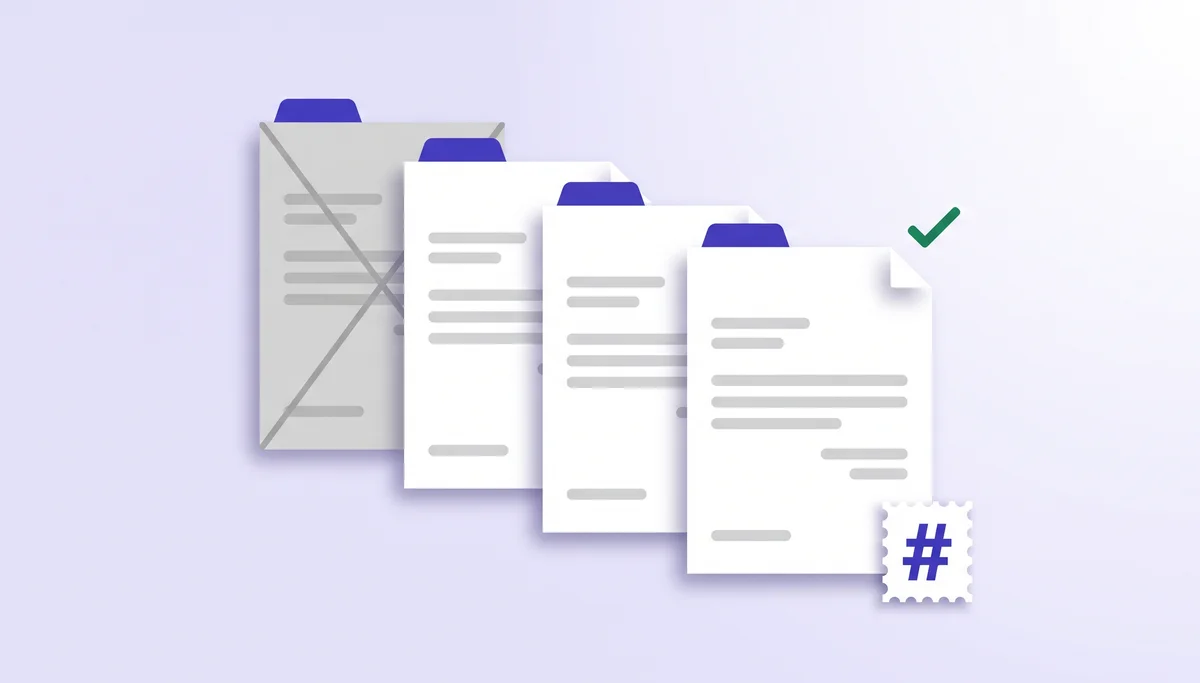
An invoice number is the reference a seller puts on each invoice so that it, and only it, can be found again. The client quotes it when paying, and the seller matches the payment to it. Any format works as long as no two invoices ever share a number.
Most businesses count upward, one number per invoice, often with a prefix. The interesting questions start when something goes wrong: a mistake, a cancelled job, a new year. A real month of invoices shows how each one is handled.
A month of invoices, mistakes included
Kestrel Translation is an invented one-person translation studio in Minneapolis. It numbers invoices KT, then the year, then a three-digit count. In October it sent seven invoices, voided one and issued one credit. Every amount below comes from our invoice generator’s engine.
| Invoice | Date | Client | Amount | Status |
|---|---|---|---|---|
| KT-2026-041 | Oct 2 | Prairie Mill Press | $672.00 | Paid Oct 19 |
| KT-2026-042 | Oct 6 | North Loop Legal Clinic | $255.00 | Paid Oct 9 |
| KT-2026-043 | Oct 9 | Cedar Lake Health Partners | $1,235.00 less $123.50 | Credit CM-2026-003 applied |
| KT-2026-044 | Oct 14 | Bluestem Arts | Void: Wrong client name; replaced by 045 | |
| KT-2026-045 | Oct 14 | Bluestem Arts Collective | $294.00 | Sent, due Nov 13 |
| KT-2026-046 | Oct 21 | Prairie Mill Press | $1,005.00 | Sent, due Nov 20 |
| KT-2026-047 | Oct 28 | North Loop Legal Clinic | $190.00 | Sent, due Nov 27 |
| Billed in October, after the void and the credit | $3,527.50 | |||
Next invoice: KT-2026-048. Credit memo CM-2026-003 ($123.50) has its own series and points back to KT-2026-043.
Three habits keep this register clean. Number 044 went out with the client’s name wrong, so it was marked void and kept, and the corrected invoice took the next number. Nothing was deleted, so the count has no unexplained gap.
The late-delivery discount on 043 was not made by editing an invoice the client already had. A credit memo with its own number reduced it instead, and both documents point at each other. The next invoice simply continues the count.
Six ways to number invoices
There is no standard format. Pick one that tells you something useful at a glance, write the rule down, and use it for every invoice. The table shows each scheme with an example and the number that follows it.
| Scheme | Last | Next | Works well for | Watch for |
|---|---|---|---|---|
| Plain sequence | 1047 | 1048 | A single business with one stream of work | Start at 1001 or similar rather than 1, so a new client does not see invoice 3 |
| Year and sequence | KT-2026-047 | KT-2026-048 | Seeing at a glance which tax year an invoice belongs to | Decide whether the count restarts each January; either way, write the rule down |
| Year reset in January | KT-2026-112 | KT-2027-001 | Keeping each year's series short | Old and new numbers differ only by the year, so always quote the full number |
| Client code | PMP-007 | PMP-008 | Several regular clients who each want their own count | Each code is its own series; keep a list of codes so two clients never share one |
| Date and count | 20261028-01 | 20261028-02 | Many invoices a day, or numbers that sort by date | Long to read out on the phone; the count resets every day |
| Job and stage | J318-02 | J318-03 | Progress billing on one long job | Still needs to be unique across the business, not only within the job |
For a small business, a prefix plus a counter is usually enough. Leave room for growth: three digits run out after 999 invoices, at which point the count simply becomes four digits long. Avoid putting a client’s name in full, since it ends up on documents other people see.
Do invoice numbers have to be sequential?
In the United States, no federal rule sets a format. IRS Publication 583 says that, apart from a few cases, the law does not require any particular kind of records, only a system that clearly shows income and expenses.
Invoices are among the supporting documents it lists, so they need to be easy to match to deposits.
Sequential numbering is still the safe habit. A gap with no explanation can raise questions in an audit or a dispute, which is why a void keeps its number in the register above.
Where VAT applies, the rule is written down. The EU VAT Directive, Article 226, requires a sequential number, based on one or more series, that uniquely identifies the invoice. HMRC’s VAT guide uses almost the same words for VAT invoices in the United Kingdom.
So a business that bills European or British customers under VAT should keep strict series, while separate series, such as one per client code, remain allowed.
Invoice number, PO number, receipt number
A single sale can carry several numbers, each issued by a different side:
- Invoice number: issued by the seller, one per request for payment.
- Purchase order (PO) number: issued by the buyer before the work starts, to approve the purchase. Large buyers’ accounts teams often match on it, so an invoice missing it can sit unpaid; copy it onto the invoice.
- Receipt number: issued by the seller after a payment arrives, one per payment. A receipt should quote the invoice number it pays, as shown in invoice vs receipt.
- Estimate or quote number: issued before the sale. Keep it in its own series, so EST-0031 can become invoice INV-1048 without confusion.
- Credit memo number: issued to reduce or cancel an invoice already sent, again in its own series.
Fixing numbering mistakes
- Two invoices with the same number. Keep the one the client has paid or recorded. Reissue the other under the next free number and tell the client which one replaces which.
- An invoice sent with the wrong details. Void it, keep it in the file, and send a corrected invoice with a new number that mentions the old one.
- A price change after sending. Issue a credit memo for the difference rather than changing an invoice the client may already have entered.
- A gap you cannot explain. Write a short note in the register saying the number was skipped and why, if you know. Do not renumber old invoices to close it.
In each case the aim is the same: anyone reading the register later can see what happened to every number.
Numbering with our generators
The free invoice generator starts at INV-1001 and accepts any format you type, including prefixes and years. It keeps your last draft in the browser, so the previous number is there to change for the next invoice. Estimates and receipts have their own prefixes, EST and RCPT, in the estimate and receipt generators.
The number is one field among a dozen. The others, from the bill-to block to the tax line, are covered in what is an invoice, and the due date printed beside the number follows the rules in Net 30 payment terms.
Sources: IRS Publication 583, Starting a Business and Keeping Records; Council Directive 2006/112/EC (EU VAT Directive), Article 226; HMRC, VAT guide (VAT Notice 700). Checked October 20, 2026.