
A Form W-4 tells your employer how much federal income tax to take out of each paycheck. A Form W-2 reports, once the year is over, what you were paid and how much was taken out. The W-4 is the instruction and the W-2 is the result.
You fill in the W-4 and hand it to payroll. Your employer fills in the W-2 and sends it to you and to the government.
| Form W-4 | Form W-2 | |
|---|---|---|
| Full name | Employee's Withholding Certificate | Wage and Tax Statement |
| Who fills it in | The employee | The employer, from its payroll records |
| Who receives it | The employer, who keeps it | The employee by February 1, 2027, and the Social Security Administration |
| When | At hiring, within 10 days of a change that leaves too little withheld, and any time by choice | After the year ends, or sooner if a leaver asks |
| What it decides or records | How much federal income tax comes out of each paycheck | What was paid and what was actually withheld for the whole year |
| Does the IRS see it? | Not unless it asks the employer for a copy | Yes, through the Social Security Administration |
| If it is missing | A new hire is withheld as single or married filing separately, with no entries in steps 2, 3 or 4 | Check the IRS online account, then the employer, then call the IRS |
| How long the employer keeps it | While it is in use, then at least 4 years after the tax was due or paid, whichever is later | A copy for at least 4 years |
| State version | Some states have their own form, some use the federal one | State wages and tax go in boxes 15 to 17 |
One year, two W-4s, one W-2
Riley Okafor, an invented employee, manages a dental office on a salary, paid every two weeks, with part of each check going into a traditional 401(k). Riley is married, files jointly, and the couple lives on this one paycheck.
Riley began the year on a plain W-4: married filing jointly, nothing else filled in. Payroll took $254.11 of federal income tax from each check:
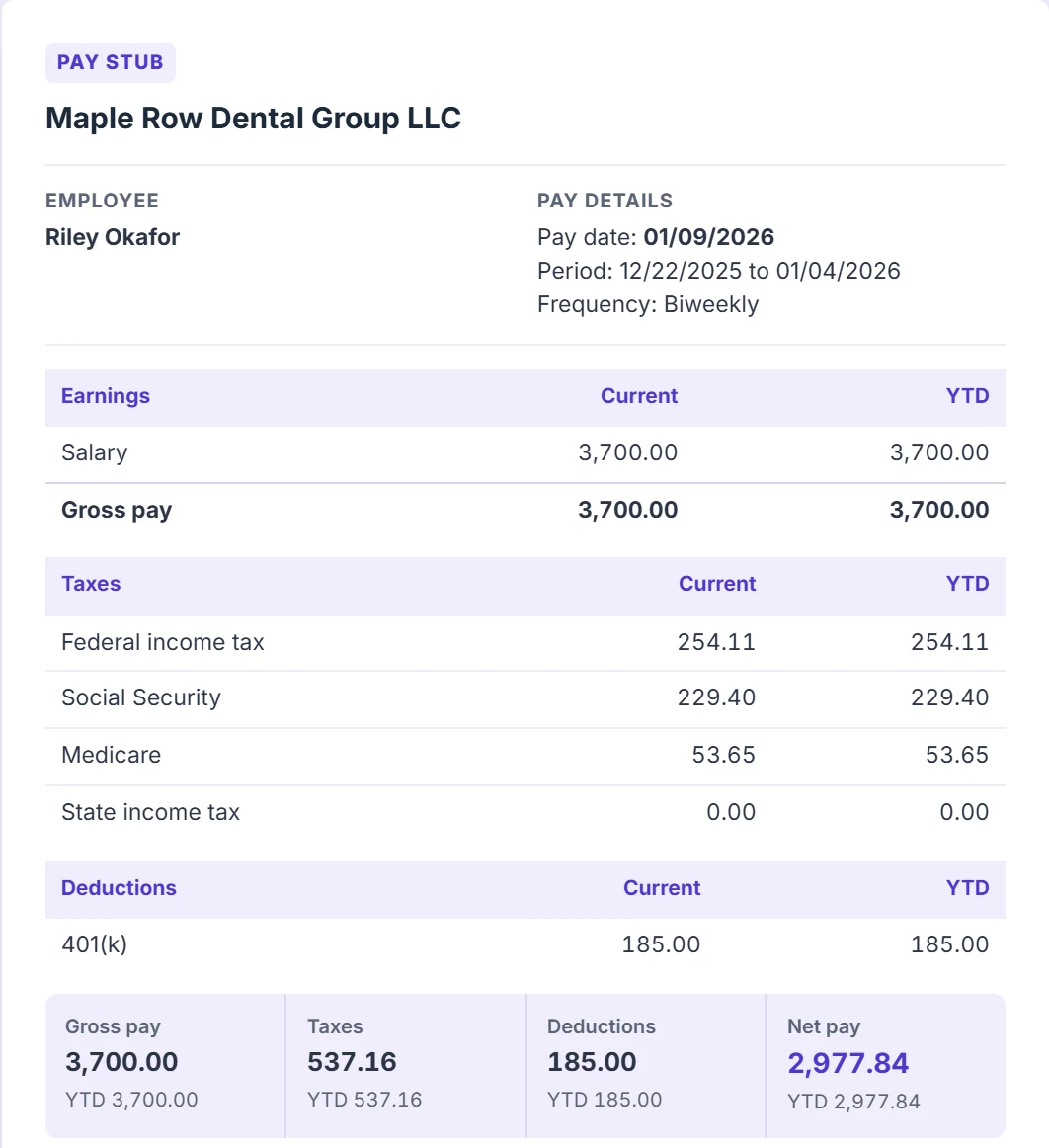
In May the couple had a baby. On June 3, Riley handed payroll a new W-4 with $2,200 in Step 3 for the child.
An employer may start sooner, but has to apply it by the start of the first payroll period ending on or after the 30th day. Here that meant the July 10 check.
The credit has conditions. The child must be under 17 at year end. The child, and you or your spouse, need the required Social Security numbers, with income at or below $200,000, or $400,000 joint. Other dependents are worth $500.
From then on, withholding dropped to $169.49 a check. Nothing went back and changed the checks already paid. The two halves simply add up:
| Paychecks | W-4 on file | Withheld each check | Withheld in total |
|---|---|---|---|
| Paychecks 1 to 13 January 9, 2026 to June 26, 2026 | Married filing jointly, nothing else | $254.11 | $3,303.43 |
| Paychecks 14 to 26 July 10, 2026 to December 25, 2026 | Same, plus $2,200 in Step 3 for the baby | $169.49 | $2,203.37 |
| Federal income tax withheld for the year, which becomes W-2 box 2 | $5,506.80 | ||
Riley’s employer reports that total in W-2 box 2, next to the wages and other taxes, by February 1, 2027.
Which W-2 boxes a W-4 can change
People often expect a W-4 to change their reported pay. It cannot. Box 1 comes from what you earned and what went into pre-tax plans. Social Security and Medicare follow your pay, whatever the W-4 says.
| W-2 box | Amount | Did the W-4 change it? |
|---|---|---|
| Box 1, wages, tips, other compensation | $91,390.00 | No. Salary minus the 401(k) deferral |
| Box 2, federal income tax withheld | $5,506.80 | Yes. The only federal amount a W-4 affects |
| Box 3, Social Security wages | $96,200.00 | No. The 401(k) deferral is still Social Security wages |
| Box 4, Social Security tax withheld | $5,964.40 | No. 6.2% of wages up to $184,500 |
| Box 5, Medicare wages | $96,200.00 | No |
| Box 6, Medicare tax withheld | $1,394.90 | No. 1.45%, plus 0.9% above $200,000 |
| Box 12, code D | $4,810.00 | No. The 401(k) deferral |
| Box 13, retirement plan | Checked | No. Active in the 401(k) |
Box 2 is not the W-4’s alone. A bonus can be withheld at a flat rate, and box 17 may follow a state form. Box 1 is lower than boxes 3 and 5 because traditional 401(k) money is taxed for income later but for Social Security and Medicare now. The code D entry shows it.
Where the refund comes from
The tax return compares box 2 with the real tax for the year.
Riley’s pay is above the limits for the earned income credit and the saver’s credit. The tax comes to about $4,406.80, since a baby born during the year can still meet the half-year residency test and the credit is not cut for a part year:
| Line | Amount |
|---|---|
| Wages from W-2 box 1 | $91,390.00 |
| Standard deduction, married filing jointly | −$32,200.00 |
| Taxable income | $59,190.00 |
| Income tax from the rates (the printed Tax Table can differ by a few dollars) | $6,606.80 |
| Child tax credit for the baby, a full year's worth | −$2,200.00 |
| Tax for the year | $4,406.80 |
| Already withheld, W-2 box 2 | $5,506.80 |
| Refund | $1,100.00 |
Riley gets back about $1,100.00, the half of the credit that the old W-4 did not know about from January to late June. With the new form in place all year, box 2 would have been $4,406.74, almost exactly the tax.
Riley could have asked for the rest in the later checks; the IRS Tax Withholding Estimator works that out. Anyone who does this should recheck in January and hand in a new W-4, or the following year can come up short.
It runs the other way too. Add a second job or freelance work and leave the W-4 alone, and box 2 can fall short, with a possible penalty. Freelance work also brings self-employment tax, which estimated payments can cover.
A refund often means too much was withheld, though credits such as the earned income credit can create one on their own.
When you must, and may, file a new W-4
You have 10 days to hand in a new one when a change cuts the withholding you can claim and too little would be taken for the year. Examples are moving from married filing jointly to single, starting another job in some cases, or no longer expecting a child credit.
If enough will still be withheld this year, a drop in filing status such as joint to single needs a form for next year by December 1, 2026, or 10 days after the change if that is later.
Every new employer needs its own signed form. Other reasons to file one:
- More than one job. Fill in Steps 3 through 4(b) on one form only, usually the best-paid job.
- A spouse who starts work. Step 2 covers this and second jobs; our W-4 guide goes step by step.
- A child or other dependent.
- Qualified tips or overtime. Step 4(b) allows for both; see tips and overtime.
- A large refund or a surprise bill last year.
A normal W-4 stays in force across years.
A claim of exemption lasts one calendar year and has to be renewed by February 16, 2027. It is only for people whose total federal income tax was zero last year, before counting what was withheld, and who expect the same this year. A refund alone does not qualify. If it lapses, payroll withholds as single.
An IRS lock-in letter overrides your form, unless the new one withholds more.
Many states use their own certificate, such as California’s DE 4, and some have no wage tax. Ask payroll which form sets your state line.
When one of the forms is missing
A new hire who hands in no valid W-4 is withheld as single or married filing separately, with nothing in Steps 2 to 4. A W-4 that is not signed is not valid.
For a missing W-2, follow the IRS order:
- Check your IRS online account.
- Ask the employer. If you left, they have 30 days from your request or final pay, whichever is later.
- After the end of February, call the IRS, which contacts the employer.
- File with Form 4852 if it still has not come. It cannot set an overtime deduction, or tips other than those on Form 4137, and if the real W-2 differs you amend.
Our guide to getting a W-2 from a former employer has the details.
Contractors get neither form
An independent contractor gives the client a Form W-9 instead of a W-4. A business that pays them $2,000 or more in a year generally reports it on Form 1099-NEC, usually with no tax withheld; the 1099 instructions list the exceptions. Employers can make year-end copies with our W-2 generator.
Questions people ask about the W-2 and W-4
Is a W-4 the same as a W-2?
No. You fill in the W-4 so payroll knows how much income tax to withhold. Your employer issues the W-2 after the year ends, showing your pay and the tax withheld.
Do I send my W-4 to the IRS?
No. Your employer keeps it while it is in use and then for at least 4 years after the tax it supported was due or paid, whichever is later. The IRS sees it only if it asks.
Can I change my W-4 after I get my W-2?
Yes. The new form changes paychecks from its start date onward. Any gap for the year already on your W-2 is settled on that year’s return. A mistake on the W-2 itself takes a corrected form from the employer.
Do I need my W-4 to file my taxes?
No. You file with the W-2. The W-4 matters for the paychecks still to come.
About the numbers: withholding uses the IRS Publication 15-T percentage method for 2026, in the same code as our pay stub generator. The two paycheck amounts, box 2 and the refund were worked out by hand and are held as tests. Rules reread and corrected November 24, 2026. Our methodology.