
“No tax on overtime” is a federal income tax deduction, not a tax-free paycheck. For 2025 through 2028, you can deduct the extra part of your overtime pay, such as the half in time and a half, up to $12,500 a year, or $25,000 on a joint return.
Your paychecks look the same as before. Social Security, Medicare and income tax are still withheld from all of your overtime. The saving arrives when you file, through a lower taxable income.
Only the premium counts, not the whole overtime check
The law calls the deductible part qualified overtime compensation: the amount above your regular rate that the federal Fair Labor Standards Act requires for hours over 40 in a workweek. Here is one invented warehouse lead’s year:
| Line | How it is worked out | Amount |
|---|---|---|
| Regular pay | 40 hours a week at $28.00, 52 weeks | $58,240.00 |
| Overtime pay | 300 overtime hours at $42.00 (time and a half) | $12,600.00 |
| Qualified overtime, W-2 box 12 code TT | Only the half: 300 hours at $14.00 | $4,200.00 |
| Overtime deduction on the tax return | Below the $12,500 cap and the $150,000 income limit | $4,200.00 |
| Social Security and Medicare still withheld on overtime | 6.2% plus 1.45% of all overtime pay | $963.90 |
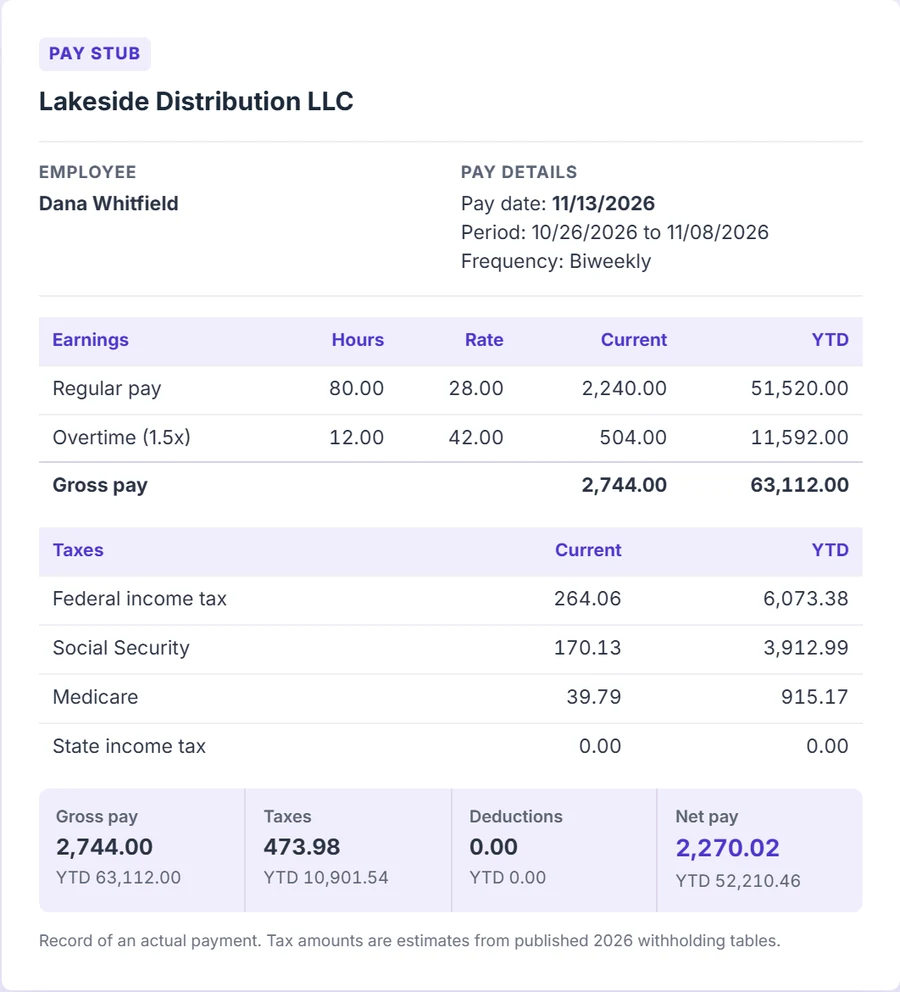
Want to see your own split? Enter your rate and overtime hours in the generator and read the overtime line; the premium is the overtime rate minus your regular rate, times the hours.
That middle line is the number to look for. From 2026, employers must report it on the W-2 in box 12 with code TT, so you no longer have to work it out from pay stubs. Our guide to W-2 box 12 codes shows where it sits on the form.
Double time, daily overtime and other edge cases
The IRS draws the line at what the FLSA requires, not at what your employer pays. That leaves some overtime outside the deduction even though it shows up on your stub:
| The week | Overtime hours | Overtime pay | Qualified overtime |
|---|---|---|---|
| 46 hours in the week, paid time and a half | 6 hours | $252.00 | $84.00 |
| 46 hours, but the employer pays double time | 6 hours | $336.00 | $84.00: only the half the FLSA requires |
| California: four 10-hour days, 40 hours in the week | 8 hours of daily overtime | $336.00 | $0.00: state overtime, not over 40 hours |
| Salaried manager exempt from FLSA overtime, paid extra under a contract | Any | Any | $0.00: not FLSA overtime |
Double time still helps, but only by the half the law requires; the rest is ordinary taxable pay. State daily overtime, like California’s after 8 hours in a day, only counts when the same hours also push the week past 40.
Workers the FLSA exempts from overtime, such as many salaried managers, get nothing here even when a contract pays them extra. If you are not sure which side of that line you are on, our guide to calculating overtime walks through the exemption tests.
Who can claim it
- You need a Social Security number valid for work, and it goes on the return.
- Married? You have to file jointly. Married filing separately gets no deduction.
- You can claim it whether you itemize or take the standard deduction.
- It goes on Schedule 1-A (Form 1040), attached to your Form 1040.
How income reduces the deduction
The full deduction is open up to a modified adjusted gross income of $150,000, or $300,000 for joint filers. Above that it shrinks by $100 for every $1,000 of income, until it reaches zero:
| Filing status and modified AGI | Qualified overtime | Phase-out | Deduction |
|---|---|---|---|
| Single, $140,000 | $12,500 | Under the limit | $12,500 |
| Single, $175,000 | $12,500 | $25,000 over, less $2,500 | $10,000 |
| Single, $200,000 | $12,500 | $50,000 over, less $5,000 | $7,500 |
| Single, $275,000 | $12,500 | $125,000 over, less $12,500 | $0 |
| Joint, $280,000 | $25,000 | Under the limit | $25,000 |
| Joint, $350,000 | $25,000 | $50,000 over, less $5,000 | $20,000 |
| Joint, $550,000 | $25,000 | $250,000 over, less $25,000 | $0 |
Most hourly workers sit well below the limit, as in the example above. The phase-out matters for high earners with a lot of overtime, or for couples where one spouse’s salary lifts the joint income.
What does not change
Social Security and Medicare apply to every overtime dollar, as before; the IRS says overtime stays wages for payroll taxes and withholding is not reduced for it. Your pay stub’s FICA lines will not shrink.
State income tax is a separate question. The federal deduction does not change your state’s rules, so check your state tax department before assuming overtime is exempt there. Our guide to FICA on a paycheck covers the payroll side.
2025 returns versus 2026 W-2s
For 2025, employers did not have to report qualified overtime separately, so many people worked it out from pay stubs using the IRS’s Schedule 1-A instructions. For 2026 onward, the employer does the arithmetic and prints the result as code TT on your W-2.
Tips get a second deduction, claimed next to this one with a different cap and tests. A server or bartender should read who qualifies for no tax on tips as well.
Check it against your final pay stub of the year. If your overtime hours times half your regular rate lands far from the code TT figure, ask payroll before you file. Our year-end pay stub guide shows where those hours appear.
Sources: 26 U.S. Code section 225; IRS questions and answers on the overtime deduction and the 2026 update (FS-2026-13); IRS overview of the new deductions; California overtime rules. The worker is invented; amounts are computed from the published figures. Checked November 13, 2026.