
Imputed income is the value of a benefit your employer gives you that counts as taxable pay, though you never receive it as cash. Payroll adds the value to your gross, usually withholds tax on it, then takes the value back out. Your check ends up slightly smaller.
Common causes are health coverage for a partner you are not married to, a gym membership, or a company car you drive home. You pay the tax on the perk, not the price of it.
One paycheck, without it and with it
Casey Lindqvist, an invented employee, inspects elevators in Knoxville, Tennessee, a state with no tax on wages. Casey is single, paid by the hour every two weeks, and has nothing extra on the W-4. Here is the plain cash paycheck, made with our pay stub generator:
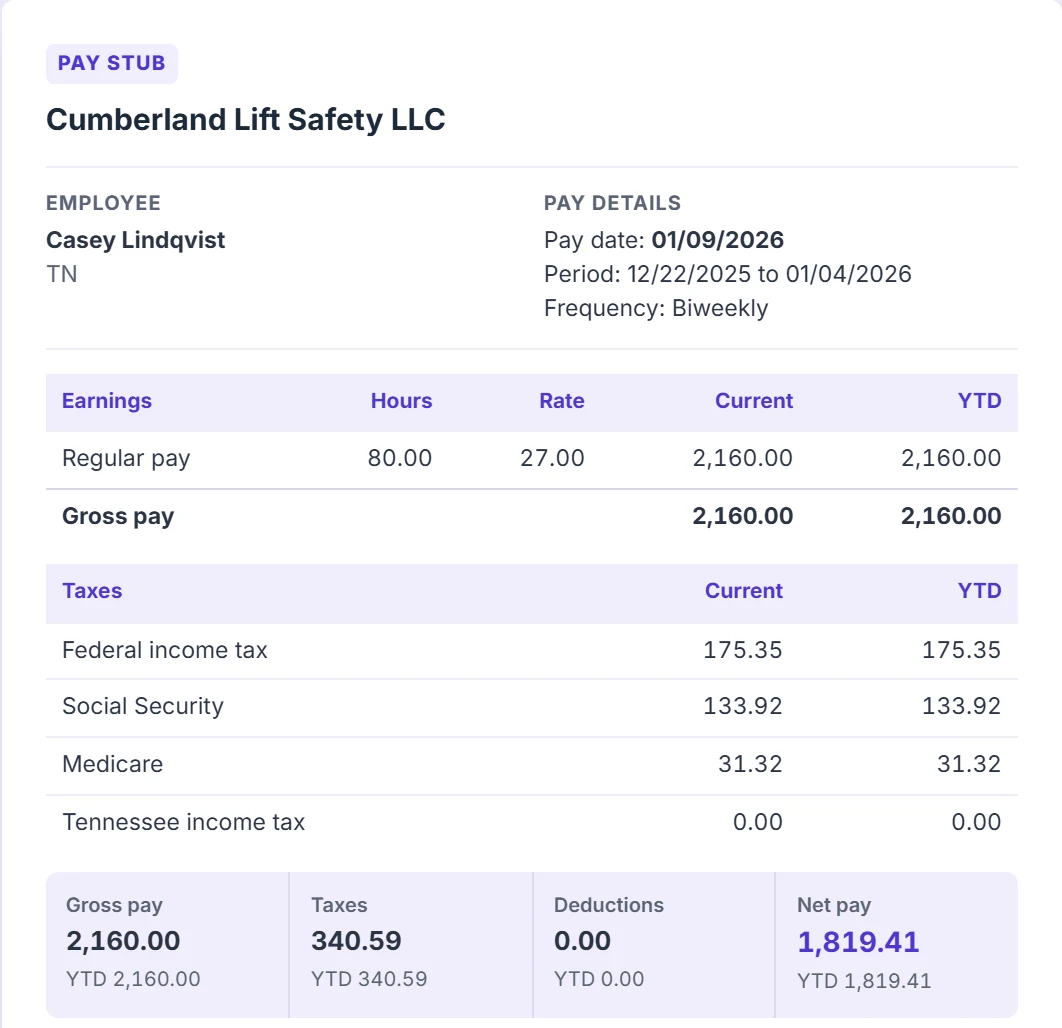
The employer also covers Casey’s partner on the health plan and pays for a gym. It requires Casey to take a company hatchback home each night, under a written policy that bars other personal use. Together those add $228.00 of imputed income to each check:
| Line on the stub | Cash only | With imputed income |
|---|---|---|
| Regular pay, 80 hours | $2,160.00 | $2,160.00 |
| Imputed: partner health coverage | $180.00 | |
| Imputed: gym membership | $18.00 | |
| Imputed: commuting in company car | $30.00 | |
| Taxable gross | $2,160.00 | $2,388.00 |
| Federal income tax | $175.35 | $202.71 |
| Social Security | $133.92 | $148.06 |
| Medicare | $31.32 | $34.63 |
| Imputed income taken back out | −$228.00 | |
| Net pay | $1,819.41 | $1,774.60 |
The cash wage stays the same. Taxable gross rises, three tax lines rise with it, and the added amount comes off again before net pay. Casey’s check shrinks by $44.81, the tax withheld on the perks and nothing more.
Labels vary by payroll system: Imputed, IMP INC, Fringe, Taxable Ben, or the benefit’s own name. A matching pair of lines, one added and one subtracted, often gives it away. Our guide to pay stub codes decodes the rest.
Which perks are added to your pay
The starting point is that a benefit is taxable unless the law specifically excludes it. Many are excluded, some only up to a limit. This is how common ones fall:
| Benefit | Added to taxable pay? | The rule |
|---|---|---|
| Health coverage for a partner who is not your spouse or dependent | Yes | Its fair market value, less what you pay for it after tax |
| Health coverage for you, your spouse, your dependents and your children under 27 | No | Excluded from pay |
| Off-site gym membership | Yes | Excluded only if the employer runs it on premises it owns or leases, mainly for employees and family |
| Gift card, even a small one | Yes | Never a minor benefit; occasional overtime meal or fare money can be |
| Driving a company car home | Usually | $1.50 a one-way trip if the commuting rule fits; some work-only vehicles are exempt |
| Life insurance over $50,000 | Yes | The IRS cost for your age, above the exclusion |
| Tuition help under a written plan | Above $5,250 a year | With no plan, usually all of it |
| Transit passes and parking | Above $340 a month each | Each has its own monthly exclusion |
| Movers your employer hires and pays | Yes | Except certain military and intelligence community moves |
| A holiday ham, flowers, an occasional office party | No | Too small to be worth accounting for |
Coverage for your spouse, dependents and children under 27 stays out of your pay. A domestic partner who is none of these falls outside the exclusion, so the value is taxable wages. Registering the partnership does not change that for federal tax.
States can differ. California, for one, leaves a registered domestic partner’s coverage out of state income tax wages, while still charging its disability insurance on it.
Large life insurance policies work from an age table. The taxable part goes in W-2 boxes 1, 3 and 5 and again in box 12 with code C, and income tax withholding on it is not required. GTL on a pay stub has the table.
How a perk gets a dollar value
The measure is fair market value: what you would pay a stranger for the same thing. What the employer paid does not decide it, and neither does what the perk is worth to you. Anything you pay toward it after tax comes off first.
Employers have to estimate that value for partner health coverage. One published method, an employer’s practice and not an IRS rule, is the University of Arizona’s. In its published example, it takes its contribution for employee plus adult ($1,190.26 a month) less employee only ($583.84), which leaves $606.42.
Casey’s $390 a month is an assumed figure of that kind.
Commuting in a company car can be valued at $1.50 for each one-way trip, but only if every condition of the commuting rule is met. The employer needs a business reason for requiring the commute and a written policy against other personal use.
For automobiles, the rule is closed to control employees, which at private employers in 2026 generally means directors, owners of 1% or more, elected or appointed officers paid $145,000 or more, and anyone paid $290,000 or more.
Other cars can use the lease value or mileage rules. Marked police cars and certain work-only trucks are not counted at all.
A repaid business cost is a different thing. Under an accountable plan, with receipts, it is not income.
Why a December check can nearly vanish
An employer can treat noncash benefits as paid each payday, each quarter, twice a year, or once a year. It also picks how to withhold income tax: add the value to your wages, or use the flat 22% rate for supplemental pay such as bonuses.
The flat rate needs income tax to have been withheld from regular wages this year or last.
| When and how | From one check | Over the year |
|---|---|---|
| Every payday, added to wages $1,774.60 take-home | $44.81 | $1,165.06 |
| Every payday, flat 22% $1,751.80 take-home | $67.61 | $1,757.86 |
| Once in December, flat 22% $61.75 take-home | $1,757.66 | $1,757.66 |
The flat rate takes more up front because Casey’s own top bracket is 12%. The extra is withholding, not tax: it counts as already paid when the return is filed. Timing is what squeezes the check, so ask payroll before the holidays which method applies.
Benefits from November and December can be counted in the following year. The benefit amount on a W-2 may therefore run from one November to the next October, and the employer has to tell you when it uses this rule.
What your W-2 will show
Imputed income folds into your ordinary wage boxes, so box 1 can exceed the cash you were paid:
| W-2 box | Amount | What is in it |
|---|---|---|
| Box 1, wages | $62,088.00 | $56,160.00 of cash pay plus $5,928.00 imputed |
| Box 3, Social Security wages | $62,088.00 | The same total |
| Box 5, Medicare wages | $62,088.00 | The same total |
| Box 14a, other (optional) | $5,928.00 | Employers may show the benefit total here |
Box 14a on the 2026 form is optional for the total, with one exception. If the employer skipped income tax withholding on a vehicle, its value must be in box 14a or on a separate statement.
To check box 1, take cash gross for the year, add the year-to-date imputed lines, and subtract pre-tax deductions such as a 401(k) or health premiums. A 401(k) does not come out of boxes 3 and 5.
Is it worth turning down?
Look at what the perk would cost you elsewhere. Declining the partner coverage and gym would cut Casey’s withholding by $38.91 a check, under the first method, and mean replacing $198.00 of benefits. The commute is part of the job, so it cannot be turned down. Before deciding:
- Check the dependent test. The health plan version ignores the income limit, so a partner you could not claim on your return may still qualify. The main tests are living with you all year and getting over half their support from you.
- Ask payroll to spread the amount, or whether the company will gross it up. A gross-up pays your tax for you and is itself taxable.
- Compare the tax with the price of your partner’s own coverage, or with marrying, which ends this kind of imputed income for a spouse.
- Paying part after tax lowers the taxable value by that amount, but costs you the full dollar to save the tax on it.
For the person running payroll
Pick the date you will treat the benefits as paid, and withhold the applicable income, Social Security and Medicare tax on it. Add the employer’s matching share and estimate reasonably for deposits.
The wages and those taxes go on Form 941, and federal unemployment tax on Form 940. Settle final values by the end of January.
For personal use of a highway vehicle you may skip income tax withholding, though not Social Security and Medicare. Tell the employee in writing by January 31 of the year or within 30 days of first providing the vehicle, whichever is later, and report it in boxes 1, 3, 5 and 14a.
Tuition help is exempt up to $5,250 a year only under a separate written plan.
Owners should check their own position: an S corporation shareholder with more than 2% does not count as an employee for the health coverage exclusion. The premiums are box 1 wages, though not always Social Security and Medicare wages. Keep your worksheet with the payroll register.
How this page was built: the wages and benefit values are invented and the tax is not. One function computes the paycheck, the chart, the timing table and the W-2, and a test confirms its cash column equals the generator’s stub. See the methodology page for the federal tables behind it. Reviewed November 24, 2026.